The Evolution of Online Gaming: From Text-Based MUDs to Modern MMOs

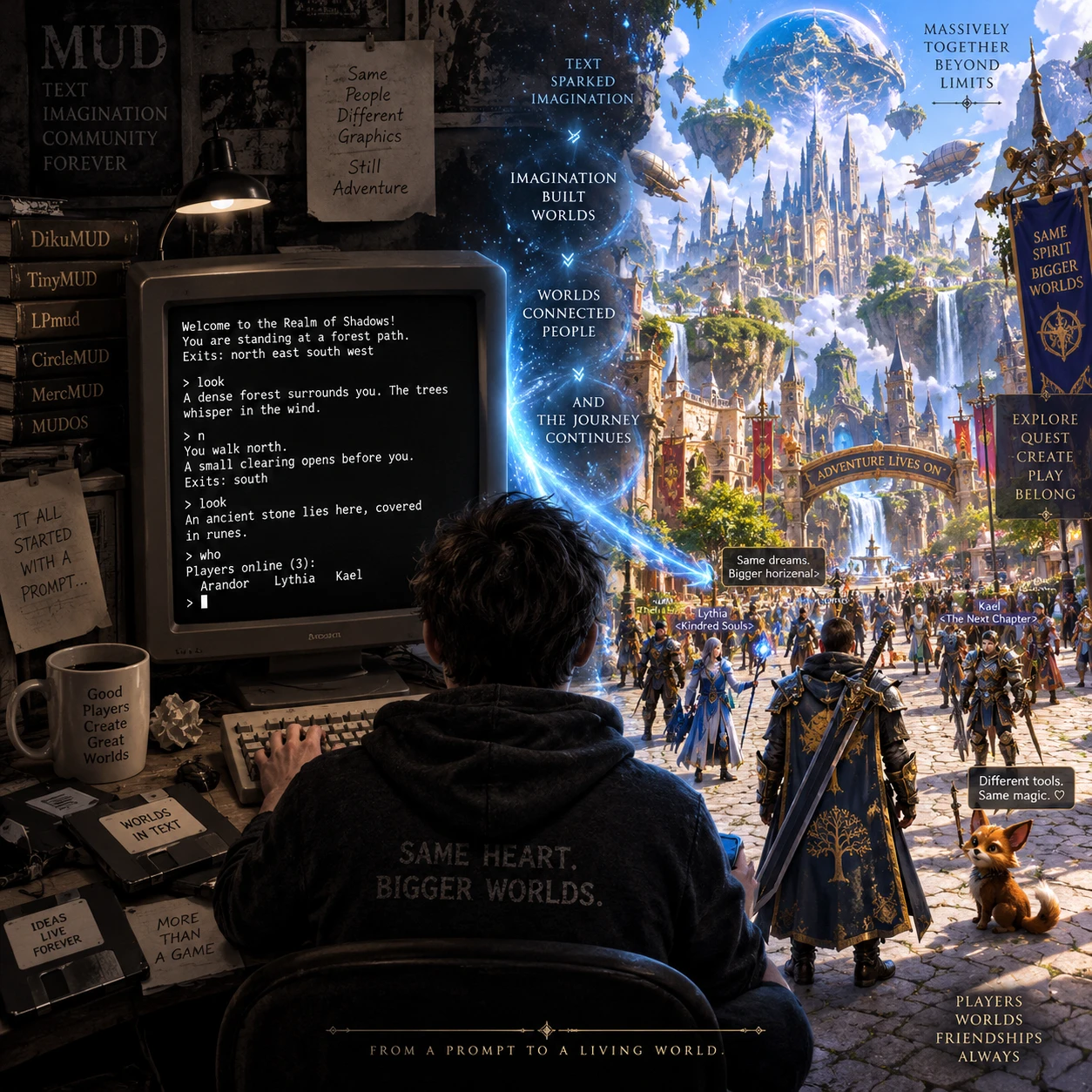
Before online games filled screens with detailed landscapes and crowds of avatars, players explored shared worlds through words. Text-based multiplayer games laid foundations for features now familiar in massively multiplayer online games: player communities, character growth, cooperation, and worlds that continued beyond a single session.
The journey from MUDs to modern MMOs was shaped by both game design and changing technology. It was not a single, straight path. Different systems and genres developed in parallel, but many of today’s online gaming ideas have clear roots in those early shared worlds.
What Were Text-Based MUDs?
MUDs, or multi-user dungeons, were online multiplayer games where players explored shared worlds and interacted mainly through written commands. Players might type a direction to move, examine an object, speak to another character, or fight a creature, then read text describing what happened.
These games asked players to build a mental picture from words. A room description could mention a stone corridor, a locked door, and a strange noise beyond it. The player supplied the imagery; the game supplied the rules and responses. That approach could feel surprisingly vivid, but it also rewarded patience and careful reading.
MUDs varied in purpose and design. Some centered on dungeons, combat, and character advancement. Others emphasized social interaction, role-play, puzzles, or player-created spaces. In many, players could see or communicate with others in the same virtual location, making the world feel shared even when its presentation was entirely text-based.
That shared presence was the important innovation. A player was not simply moving through a fixed story alone. Other people could arrive, offer help, compete for resources, or change the course of an encounter. Player communities formed around those interactions, and the written interface often encouraged conversation because communication was already part of play.
The Shift from Text to Graphics
Graphical multiplayer games made online worlds easier to see and navigate by replacing many written descriptions with visual environments. Characters, locations, and actions appeared on screen, which helped new players understand what was happening without learning a command vocabulary first.
Graphics changed immersion in a practical way. A map, animated character, or visible doorway could communicate information at a glance. Players could recognize one another by appearance and watch movement unfold in real time. This made navigation more immediate and gave game designers new tools for staging combat, exploration, and social encounters.
But visual presentation came with costs. Graphics required more computing power and bandwidth than text, and a detailed interface could make a game more demanding to build and run. Text games could describe a vast range of events with a few lines; graphical games had to represent many of those events through art, animation, and software systems.
The shift did not erase text-based multiplayer games. Instead, it broadened access and changed expectations. Visual worlds made online play more legible to casual players, while text remained valuable for chat, quests, system messages, and role-play. Later games combined both forms: a visual world supported by written communication.
The Internet Makes Larger Worlds Possible
Improved internet connectivity and online game servers allowed more players to share game spaces over greater distances. As networks became more accessible and reliable, multiplayer play could move beyond small groups connected in one place and support larger, ongoing experiences.
Early online systems often faced limitations in speed, access, and capacity. A slow or unstable connection could interrupt a session, while server resources constrained how many players could participate. As internet infrastructure and computer hardware improved, developers gained more room to build games in which players met online, returned regularly, and interacted through centrally managed servers.
Servers also helped establish a consistent version of the game world. Instead of each player keeping an isolated copy of every event, an online game server could manage shared state: who was logged in, what had happened in an area, and which characters or objects were present. The exact architecture differs from game to game, but server-based play became a key part of supporting larger online communities.
Connectivity alone did not create compelling worlds. Developers still had to decide what players could do together and why they would come back. A bigger player count can make a world feel lively, yet it can also bring crowded spaces, technical strain, or interactions that are difficult to manage. The challenge was to make scale serve play rather than treat it as a feature by itself.
The Rise of MMORPGs
MMORPGs brought large numbers of players into persistent online worlds where characters could develop over time. Their defining appeal came from combining exploration, progression, shared activities, and social systems in a world that continued to exist when any one player logged out.
Persistence changed the relationship between player and game. A character could gain experience, acquire equipment, learn abilities, or build a reputation across many sessions. Quests and encounters gave individuals goals, while groups could tackle challenges that were difficult or impossible to complete alone. Guilds, parties, trading, and in-game chat gave players practical reasons to organize.
Avatars became a central part of that experience. A character’s appearance and abilities offered a way to express identity, while progression created a record of time and effort. This could make a virtual world feel personal. It could also create pressure to keep up, especially when advancement depended on repeated play or when schedules shaped access to group content.
MMORPGs did not all follow the same formula. Some emphasized combat and character builds; others placed more weight on role-play, crafting, exploration, or player-driven economies. Their common thread was a designed relationship between persistent worlds and social play: the world gave players places to meet, and the community gave those places meaning.
How Modern MMOs Build on the Past
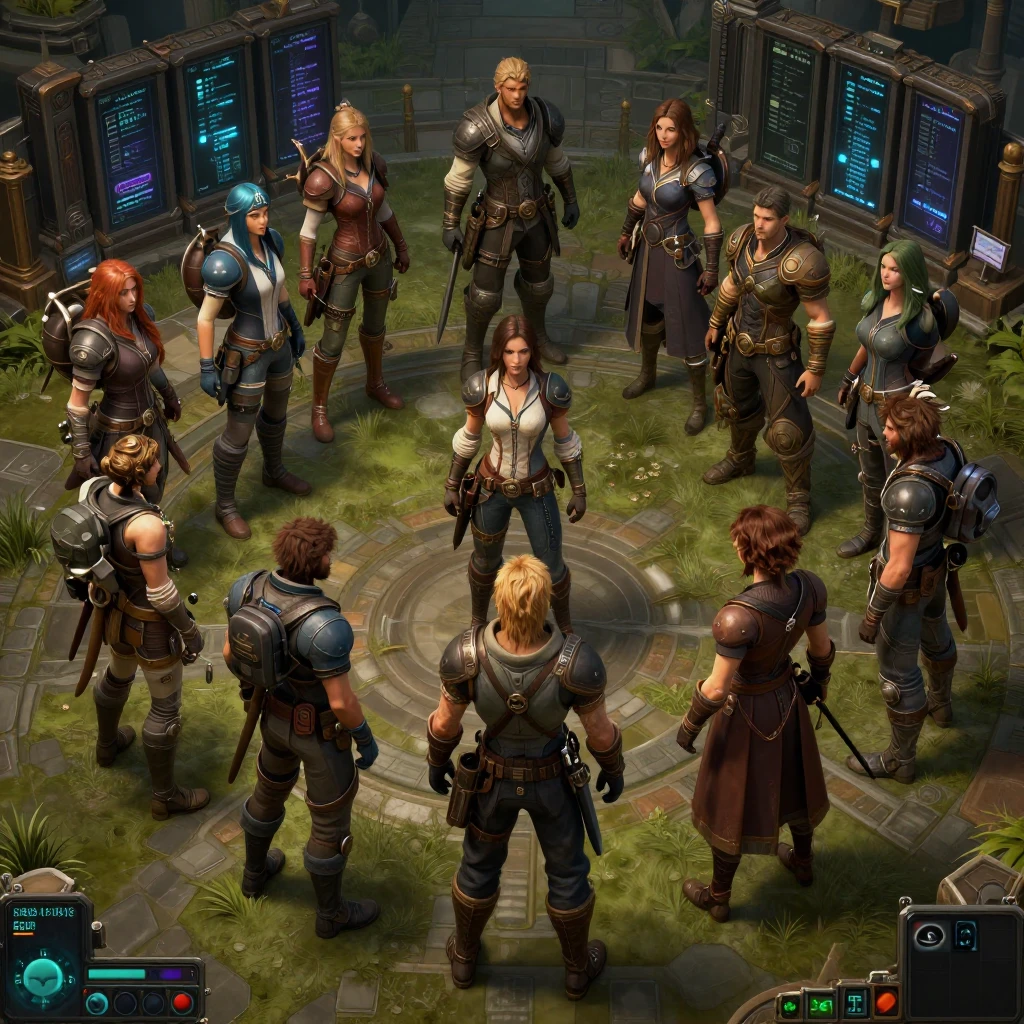
Modern MMOs build on early MUD ideas by preserving shared spaces, player communication, exploration, and cooperative play while presenting them through rich graphics and complex online systems. The interface has changed dramatically; the need for players to make a world feel alive has not.
Many familiar features have clear parallels with text-based games. A map replaces a room description, but both help players orient themselves. A party finder formalizes the process of meeting companions. Chat channels and guilds extend the social bonds that once grew through direct conversation in a shared room. Quests and character progression give players reasons to return and build a history with their avatars.
Modern design also adds features that were harder to support in early systems: large-scale events, voice communication, matchmaking, cross-platform play in some titles, and frequently updated worlds. These tools lower barriers to participation. Matchmaking, for example, can help a solo player find a group quickly, though it may offer less of the informal community-building that comes from organizing a team yourself.
There is a useful way to understand this inheritance: look at an MMO through three layers. The world layer gives players places to explore; the progression layer gives their actions continuity; the community layer turns other players into companions, rivals, and collaborators. A modern game may excel at one layer and feel thin in another. Impressive visuals cannot guarantee meaningful social play, just as a lively community cannot fix every frustrating system.
What Changed—and What Stayed the Same?
The biggest changes are presentation, scale, and convenience; the enduring elements are exploration, identity, cooperation, and the presence of other players. Comparing text-based games with modern MMOs shows how much technology has expanded the experience without replacing its social core.
Text-based MUDs relied on imagination and typed commands, while graphical multiplayer games use visual cues, animation, and interfaces to make actions more immediate. Internet connectivity and online game servers have also supported larger populations and persistent systems. Modern players can often find groups or communicate through tools that early games could not provide.
Some trade-offs remain. Text gives players room to interpret a world, while detailed graphics make it easier to share a specific visual experience. Automated systems can reduce waiting, but a little friction sometimes leads to conversation and lasting friendships. Persistent progression provides a sense of investment, yet it can make a game feel like an obligation if every activity becomes a task to complete.
Across formats, the fundamental appeal is remarkably stable: enter a world, discover what is there, and see how other people respond. MUDs showed that a compelling online game did not need a realistic image of a world. Modern MMOs demonstrate what becomes possible when that shared imaginative space is supported by graphics, widespread connectivity, and evolving server technology.
Frequently Asked Questions
These answers explain the key terms behind the evolution from MUDs to modern MMOs, including persistence and design influence.
What does MUD stand for?
MUD stands for multi-user dungeon. The term refers to a category of online multiplayer games, many of which presented shared environments through text and accepted typed commands.
How did MUDs influence MMORPGs?
MUDs helped establish shared worlds, player-to-player communication, character development, exploration, and cooperative activities. MMORPGs expanded these ideas with graphical interfaces, larger populations, and more elaborate online systems.
What makes an MMO world persistent?
A persistent world continues to exist and retain important game state when an individual player logs out. Online game servers typically manage that shared state, although the details vary by game.
Are modern MMOs still based on ideas from text games?
Yes. Many modern MMOs still rely on ideas familiar from text-based multiplayer games: shared spaces, exploration, player communities, progression, and cooperation. The presentation and technology have advanced, but those design foundations remain recognizable.